
Most HighLevel SaaS founders building a HighLevel SaaS growth system know they need video. They just do not know where to put it.
So they make one. A polished explainer, a screen-recorded demo, maybe a quick promo clip. They drop it on their homepage, share it in a Facebook group, and then wonder why it did not move the needle.
Without a defined HighLevel SaaS video strategy, video is nothing more than a content tactic. When mapped deliberately, it becomes a system-level asset: one that works quietly and consistently at every stage of your SaaS lifecycle, whether or not you are actively pushing it.
This post is about that shift. How to stop using video occasionally and start deploying it as one of the most functional pieces of your HighLevel SaaS growth system.
Why Most High-Level SaaS Founders Have No Video Strategy
There is a familiar pattern in early-to-mid-stage SaaS businesses: video gets created in reaction to a problem.
When prospects do not understand the product, they make a demo. If the onboarding feels clunky, they record a walkthrough. A customer asks for a feature tutorial, they screen-record it and send it over.
Each video is a one-off solution to an immediate pain. There is no map, no intention, no system thinking behind any of it.
The result? A scattered library of assets that do not connect.
Your sales page has a general explainer. Your onboarding has one walkthrough trying to cover everything. Your support team is still answering the same questions every week. And when a lead watches your demo, they are not even sure it applies to them.
Most SaaS brands direct the majority of their video effort toward awareness content, while the mid and lower funnel — where conversions actually happen — barely get touched. That is not a content problem. It is a placement problem rooted in a lack of system thinking.
The fix is not to make more videos. It is to make the right videos and put them in the right places.
Video as a System-Level Asset for Your HighLevel SaaS
Here is the reframe: stop thinking about video as something you publish. Start thinking about it as something you deploy.
Published content lives on a timeline. You post it, it gets some traction, it fades. A system-level asset lives inside a process, permanently and structurally, and does a specific job every time a user hits that point in their journey.
Think about the highest-leverage pieces of your HighLevel SaaS business right now: your pricing page, your checkout flow, your onboarding email sequence. You did not build those casually. You built them with intention, placed them precisely, and let them work on your behalf every single day. That is exactly how video should function.
A welcome video inside your onboarding flow is not a piece of content. It is an activation mechanism. A short tutorial embedded in your help center is not a blog post. It is a support deflection tool that runs 24/7. A sales explainer on your landing page is not a brand play. It is a conversion asset doing real commercial work.
The moment you start thinking about video this way, by function and not by format, everything about how you create and place it changes. This is what a GoHighLevel white-label video looks like inside a HighLevel SaaS growth system. Systems beat volume. One well-placed video outperforms ten videos without a strategic home.
GoHighLevel White-Label Video Across the HighLevel SaaS Lifecycle
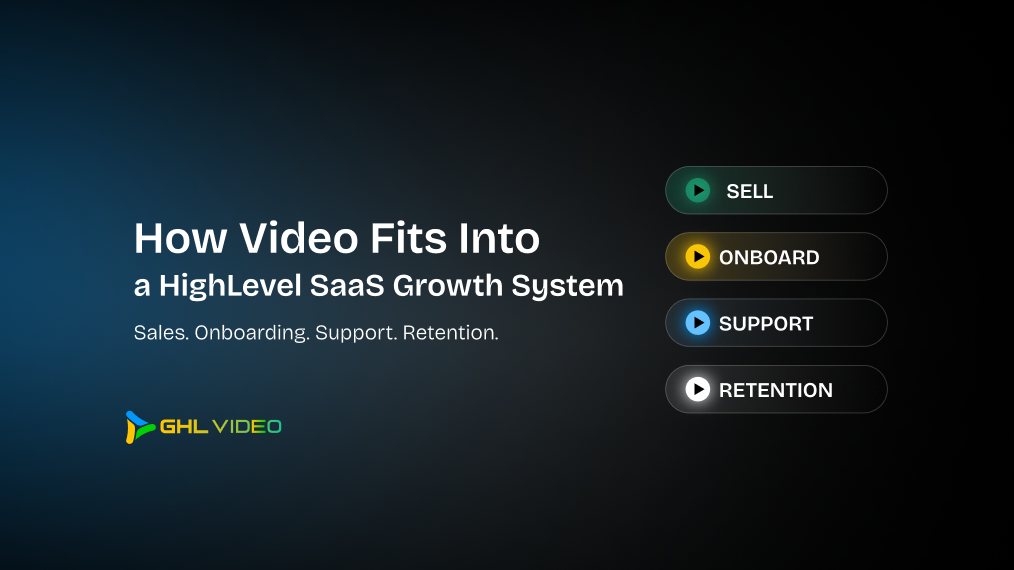
Your HighLevel SaaS has distinct lifecycle stages, and each one has a specific video job to do. Here is how it maps out.
Sales
At the sales stage, the goal is clarity and trust, fast. Your prospect has found you. Now they need to understand what you offer, why it is different, and whether it is for them. All of that needs to happen before they lose interest.
Most HighLevel founders treat the sales stage as a single moment. It is not. A prospect moves through several micro-decisions before they book a call or click “buy.” They need to understand what the platform is, see it in action, believe it is built for someone like them, and trust that the brand behind it is professional. Each of those micro-decisions needs its own video.
Here is how each GHL Video type fits into the sales stage, specifically for video for HighLevel resellers and white-label agency owners.
The Brand Explainer (First Impression and Cold Traffic)
This is the video that does the heaviest lifting at the top of the sales funnel. It lives on your homepage, inside cold outreach sequences, and in your DMs when a prospect asks: what exactly is this?
Its job is not to show every feature. Its job is to communicate what your white-label SaaS does, who it is for, and why it matters, in under 90 seconds, before the prospect loses interest or bounces.
The most common mistake here is using a generic HighLevel demo as the explainer. Your prospect does not care about HighLevel. They care about their problem. The explainer needs to open on their pain, show your branded platform as the solution, and close with a single clear next step. Not a tour. A pitch.GHL Video produces six explainer versions covering the most common HighLevel SaaS positioning angles: all-in-one platform, AI Employee, reputation management, social planning, outreach automation, and a full platform overview. Each one is fully customized with your brand and built to convert cold attention into genuine interest.
The Demo Video (Mid-Funnel Conversion)
Once a prospect understands what your SaaS is, their next question is: but does it actually do what I need? That is the demo video’s job.
The demo video lives on your sales page, inside your proposal documents, and in your mid-funnel email sequences. Specifically in the follow-up emails that go out after a prospect has expressed interest but has not yet booked a call or purchased.
A well-built demo video eliminates a significant percentage of live sales calls by pre-qualifying and pre-convincing prospects before they ever speak to you. The founders who have a demo video in their sales sequence consistently report shorter sales cycles, higher call quality, and better close rates, because the prospects who do get on a call have already done the mental work of saying yes.
GHL Video produces three demo video formats. Demo V1 is spokesperson-led, designed for SaaS founders who want a professional presenter voice carrying the walkthrough. Demo V2 covers the core platform without AI-specific positioning, suited for niches where the AI angle is less relevant. Demo V3 is the most current and covers HighLevel’s full AI capabilities, making it the strongest option for 2026 when prospects are evaluating AI features before almost anything else.
The wrong placement mistake here is putting the full demo at the top of the sales page before the prospect has bought into the concept. Give them the explainer first. Give them the why before you give them the how. The demo belongs one step deeper, after initial interest has been established.
Feature Animation Videos (Objection Handling and Specificity)
Most prospects have one or two specific features they need to see before they will commit. For HighLevel SaaS buyers in 2026, those features are almost always AI-related: AI booking, AI conversation management, AI social planning, reputation automation.
Feature animation videos are short, focused assets that cover individual platform capabilities in 30 to 90 seconds each. They live in sales sequences as supporting content, on specific sections of the sales page alongside feature callouts, and inside proposal documents when a prospect has asked about a specific capability.
Their role in the sales stage is objection removal. When a prospect says they are not sure if it handles a specific feature, you send the animation for that feature. When a prospect is comparing you to a competitor and wants to see the automation workflow, you send that clip. Each animation is a pre-built answer to a specific buying question.GHL Video produces feature animations in packs of 7, 15, and 23. The full pack covers the most frequently evaluated features across HighLevel SaaS sales conversations. Founders who have the full pack can respond to any feature question with a branded professional video rather than a screen recording or a Loom.
Marketing Videos (Paid Ads and Social Selling)
The sales stage does not only happen on your website. It happens in your ads, in your social content, in your direct message follow-ups, and in the communities where your prospects are spending time.
Marketing videos are built specifically for these environments. They are shorter, punchy, and designed to stop a scroll or convert a click rather than explain an entire platform. They open on a single pain point, show a single outcome, and end with a single call to action.
These videos live in your paid ad campaigns on Meta and Google, in your organic social posts on LinkedIn and Facebook, in your cold outreach sequences as pattern-interrupt assets, and in community posts where a text-only response would get ignored. GHL Video produces marketing videos as singles or in packs of 5, 10, and 21. Founders running paid ads without purpose-built video creative are paying for traffic that lands on a page doing less work than it should. The marketing video pack closes that gap by giving the sales funnel a top-of-funnel entry point that matches the professional quality of everything downstream.
Short Explainer Videos (Landing Page Clarity and Feature Breakdown)
Short explainer videos occupy a specific role in the sales stage that the brand explainer and demo video do not cover: explaining individual use cases and feature benefits concisely for prospects who are already partially sold but need one more point of clarity before acting.
They live on dedicated landing pages for specific niches or campaign angles, inside email sequences as single-topic education pieces, and on sales pages alongside specific sections rather than as the main hero video.
Where the brand explainer answers what is this and the demo answers how does it work, the short explainer answers why does this specific capability matter for my specific situation. That granularity is what converts the prospect who has watched the main demo and liked it but still has one unanswered question holding them back.GHL Video produces short explainers as singles or in packs of 5, 10, and 26. For founders targeting multiple niches or running multi-angle campaigns, the short explainer pack gives each landing page and each audience segment its own purpose-built video rather than forcing every prospect through the same generic content.
The Full Sales Video Stack
A HighLevel SaaS founder with a complete sales video stack has the following assets working simultaneously across the funnel.
A brand explainer converting cold traffic on the homepage and in outreach. A demo video pre-qualifying and pre-convincing prospects in the mid-funnel. Feature animations handling objections and answering specific capability questions. Marketing videos feeding top-of-funnel awareness through paid and organic channels. Short explainers sharpening clarity on specific landing pages and campaign angles.
Each one is doing a specific job for a specific person at a specific moment in the buying journey. None of them are doing each other’s job. And none of them are asking a prospect to do more cognitive work than they are ready to do at that stage.
That is what a sales video system looks like. Not one video trying to do everything. Five video types each doing one thing well. You can see the full breakdown of what is included in the Complete HighLevel Video Stack.
The wrong version of this is still what most HighLevel founders are running: one generic demo on the homepage, used everywhere, doing nothing particularly well anywhere.
HighLevel SaaS Onboarding Video: What Belongs Here
Onboarding is the most underused and highest-leverage placement for video in any HighLevel SaaS.
When a new user logs in for the first time, they are disoriented. They need fast, clear guidance. Studies show users retain 95% of information from video compared to just 10% from text. Adding video to onboarding emails can increase click-through rates by up to 300%. The right videos here are short, sequenced, and purposeful: a welcome video that sets expectations, a first-win walkthrough that shows them the one action to take first, and focused tutorials at each key milestone.
Wrong placement mistake: one long onboarding video that tries to cover the entire platform. Nobody finishes it, nobody remembers it, and your support tickets stay exactly where they were.
Support
Every repeated support ticket is a signal. It means there is a friction point that a short tutorial video can remove permanently.
Video embedded in your help center or in-app resource center acts as asynchronous support that scales without adding headcount. A user stuck on automations at 11pm does not need to file a ticket. They need a 90-second walkthrough showing them exactly what to click. This kind of resource becomes a structural part of how your SaaS delivers value, reducing churn risk that would otherwise be invisible.
Wrong placement mistake: a help center full of text articles with no video. Text explains. Video demonstrates. For a platform as visual and workflow-heavy as HighLevel, demonstration wins every time.
Retention
Retention videos are the most overlooked category in the SaaS lifecycle. Most founders stop thinking about video the moment someone is paying.
But the customers most at risk of churning are the ones who never fully activated. The ones who signed up, poked around, got confused, and quietly disengaged. A well-timed re-engagement video, delivered via email or in-app notification, can pull those users back toward a feature they have never touched. Short testimonial or case study videos, placed at the right moment, reinforce the value of staying by showing real customers winning with the same platform.
Wrong placement mistake: assuming retention is handled by email copy alone. Video communicates urgency, warmth, and proof faster than any paragraph can.
Common Placement Mistakes
Inside any HighLevel SaaS growth system, the same video can succeed or fail entirely based on where it lives. Here are the most frequent missteps.
- Using a sales video for onboarding. A video built to convince a stranger does not serve someone who has already bought. Different stage, different job, different video.
- Front-loading demos with features. Long feature walkthroughs belong at the bottom of the funnel, not the top. Lead with transformation, not functionality.
- Burying the onboarding video in a welcome email. People do not click links without a reason. Give them context and tell them what they will learn in 90 seconds before they watch.
Creating without placement. This is the root of all the above. If you do not know where a video will live before you make it, you are creating content and not building a system. Decide the placement first. Then script to match.
How GHL Video Fits Into Your GoHighLevel Video Marketing Strategy
This is exactly the gap that GHL Video was built to fill.
Most HighLevel SaaS founders do not have the time, resources, or expertise to build out a full video system from scratch. Scripting, producing, animating, and voicing a library of lifecycle-ready videos takes months if you are doing it alone. The output is also inconsistent.
GHL Video specializes exclusively in GoHighLevel white-label video system production for HighLevel SaaS resellers and agencies. We have been inside the HighLevel ecosystem since 2019. Our team understands everything about HighLevel. When we build a video, every video is built with the HighLevel ecosystem in mind: the features, the workflows, the positioning. You are not hand-holding a generalist agency through what a snapshot is or why sub-accounts matter.
Premade Video Libraries
Professionally produced HighLevel explainers, tutorials, and feature walkthroughs are already built, branded to you, and ready to deploy. Best when you need content quickly, you are covering standard HighLevel features, or you are building out your help docs, client portals, or support systems on a budget.
Custom Video Production
Fully tailored to your product, audience, and brand. Scripts written from scratch, your white-labeled dashboard recorded, your brand guidelines built in. Best when you need demo videos for your sales page, you have customized HighLevel for a specific vertical, or you need complete control over messaging and positioning. Learn more about custom video production and what is included.
Custom production takes around 15 to 30 days in most cases, and 7 days for fast demo videos. It costs more, but delivers a video that is perfectly aligned with your business.
The smartest approach? Most successful HighLevel businesses use both. Custom videos for sales pages and core onboarding. Premade videos for feature explanations and recurring support questions. You get comprehensive coverage without custom-producing everything from scratch. Not sure which fits your stage? Read: Premade vs Custom: Which Video Option Is Right for Your HighLevel SaaS
Video Editing Service for HighLevel Content Creators and Agencies
If you are regularly producing HighLevel content, editing is likely consuming 15 to 20 hours of your week. GHL Video’s editing service pairs you with a dedicated, HighLevel-certified editor who already understands the platform. No onboarding, no repeated explanations. Every plan includes unlimited requests, unlimited revisions, 4K exports, color grading, and a professional music library.
You should not be figuring out video production while also running your SaaS. Bring in specialists who already live inside the system you are building on.
Build Your HighLevel SaaS Growth System Around Video
A single great video will not grow your SaaS. A mapped, placed, and intentional HighLevel SaaS growth system built around video will.
When you stop asking whether you need a video and start asking what job needs doing at this stage of your customer’s journey, everything sharpens. Your sales process gets clearer. Your onboarding activates faster. Your support load drops. Your retention holds longer.
That is what it means to treat video as a system-level asset. Not something you create and publish. Something you build into the machine.Want to see how this looks in practice? Book a free strategy call with the GHL Video team and we will map the exact video system your HighLevel SaaS needs at your current stage.